

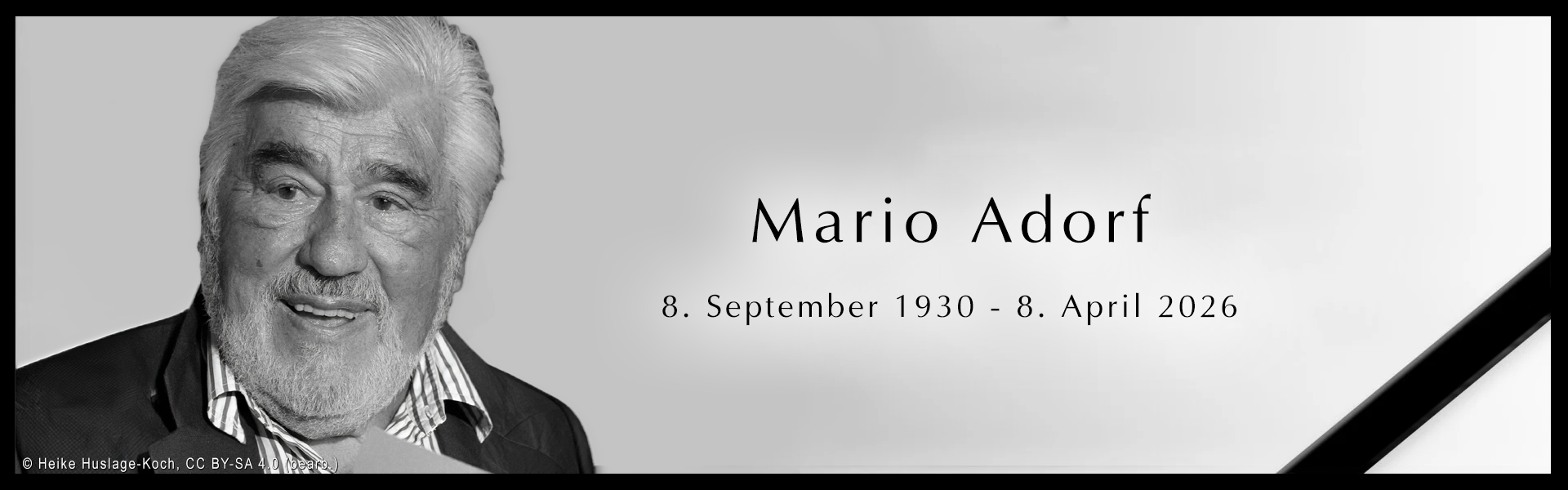
On April 8, 2026, Mario Adorf passed away at the age of 95 in his apartment in Paris. With his passing, European cinema has lost one of its last great character actors—and a figure who helped shape postwar German cinema for over seven decades.
Mario Adorf was never a conventional actor. He was a force of nature. Since his film debut in 1954 in Paul May’s war drama 08/15, he brought a physical intensity to the screen that German cinema had never seen before. He owed his breakthrough to the role of the alleged serial killer Bruno Lüdke in Robert Siodmak’s The Devil Strikes at Night (1957), for which he received the German Film Award for Best Newcomer—an award that set the course for his career: from then on, Adorf played the unpredictable, the driven, the dangerous.
His range was enormous. He worked with Sam Peckinpah (Major Dundee), Billy Wilder (Fedora), and Claude Chabrol, shot Spaghetti Westerns with Sergio Corbucci, and portrayed the legendary villain Santer in Winnetou I. In Fernando Di Leo’s Caliber 9, he played a hot-tempered mafioso who oscillated between outbursts of rage and silent menace. But he found his most significant roles in New German Cinema: as the Tin Drum’s father, Alfred Matzerath, in Volker Schlöndorff’s Oscar-winning The Tin Drum (1979) and as a corrupt real estate speculator in Rainer Werner Fassbinder’s Lola (1981). Adorf’s art lay in portraying villains so humanly that the audience found themselves on the side of evil—and did not regret it in the least.
The UCM.ONE catalog features no fewer than four films starring Mario Adorf: Gerd Oswald’s The Day the Rains Came (1959), in which Adorf displays his full physical charisma as a young gang leader; Will Tremper’s The Endless Night (1963); the political drama The Assassination of Matteotti (1962); and Caliber 9 (1972). Tremper’s film deserves special mention: shot without a finished script, at night in the departure hall of Berlin-Tempelhof Airport, Adorf makes a wordless cameo appearance—for a few seconds, he knocks in vain on the window of his beloved, who rejects him. A scene without dialogue, and yet unmistakably him. The film, now a historically significant part of the UCM.ONE distribution catalog under the label Darling Berlin, was rediscovered in the retrospective at the 2024 Berlinale. Klaus Lemke once said: “Without Will Tremper’s The endless Night, German postwar cinema would be a great mistake.”
With his final stage show, Zugabe, Adorf had thanked his audience for their “decades of loyalty.” It was a gesture that, in its simplicity, said everything about an actor who made over 200 films and never stopped taking his counterparts seriously—whether in front of the camera or in the theater.
Mario Adorf is survived by his wife Monique, his daughter Stella, and his grandson Julius.
